General educational information only. Not medical, legal, or official emergency advice. Always follow your local authorities. Official instructions come first.
Front matter
How to Use This Book
This book is built for two very different moments: a calm afternoon when you have time to prepare, and the first minutes of a real emergency, when you do not.
In an emergency right now
- Follow official instructions first. Emergency alerts, the police, the fire service, and local authorities know your situation better than any book.
- Find your event in the Contents or in the Find It Fast index at the back. Every event has a short code, such as
NAT-EQfor an earthquake orTECH-GRIDfor a blackout. - Go to the event's MUST DO box. Do those steps in order.
- Only then move on to the first hour, the first 24 hours, and beyond.
Before an emergency
- Read Part 1, Universal Foundations. It takes about two hours.
- Fill in the Customize for Your Location worksheet.
- Build your first kit. Start with the 72-hour go-bag in FND-KIT.
- Use the risk matrix in FND-RISK to pick your three most likely events. Read those chapters, and copy their quick cards from APX-CARD.
How the book is organized
| Part | What it covers | Use it |
|---|---|---|
| Part 1: Universal Foundations | Mindset, plans, risk assessment, kits, documents, and offline knowledge | Before anything happens |
| Part 2: Core Survival Skills | Water, fire, shelter, first aid, navigation, communication, food, sanitation, security | Learn ahead; refer back during events |
| Part 3: Event Modules | 24 events, from earthquakes to grid failure to pandemics | During an event |
| Part 4: Recovery | Returning home, getting help, emotional recovery, community resilience | After an event |
| Appendices | Master checklists, official resources by country, glossary, quick-reference cards, index | Print, laminate, keep handy |
Event codes
Every chapter has a code. The first part names the family; the second names the event. NAT-EQ, for example, is the earthquake chapter in the natural-disasters family.
| Prefix | Family | Prefix | Family |
|---|---|---|---|
FND | Foundations | GEO | Conflict and unrest |
SKL | Core skills | BIO | Biological |
NAT | Natural disasters | RARE | Rare, very large events |
TECH | Technology and infrastructure | OTH | Economic, supply chain, compound events |
REC | Recovery | APX | Appendices |
When the text says See followed by a code, the page number is printed next to it.
The seven boxes
Each kind of information always sits in the same kind of box, with the same symbol and label. The book still works printed in black and white or read in poor light.
| Box | Label | Means |
|---|---|---|
| Heavy black border, warning triangle | MUST DO | Life-safety actions. Do these first, in order. |
| Double rule, check box | PREPARE | Things to do before an event. |
| Dashed border, up arrow | RECOVER | After the danger has passed. |
| Gray panel, "i" symbol | KNOW | Background you should understand. |
| Black panel, crossed circle | AVOID | Places and actions that hurt people. |
| Dotted border, map pin | CHECK LOCALLY | You must look this up for where you live. |
| Light panel, branching symbol | DECIDE | A quick decision tree at the top of each event chapter. |
Every event chapter follows the same order
- Decide in 30 seconds
- Overview, risks, and warning signs
- Immediate actions: 15 minutes, 1 hour, 24 hours, beyond
- What you need
- What you must do (step-by-step procedures)
- Safer locations (principles, not exact places)
- Places and actions to avoid
- Long-term strategies and recovery
- See also
- A quick-reference card to copy or photograph
In a few shorter chapters, parts 6 and 7 share one section.
Each chapter repeats its own critical steps, so in a crisis you never need to leave the chapter you are in.
A note on units and numbers
Measurements are given in metric first, with US units in parentheses. Figures such as "about 4 hours" or "at least 6 m (20 ft)" come from widely published public-safety guidance and are rounded so they are easy to remember. Your local authority's figures always take priority.
Part 3 · Event modules · TECH-GRID
Grid Blackout
When the power fails across a neighborhood, a city, or a region, the first hours decide how comfortable and safe the next days will be.
Decide in 30 seconds
- Is anyone in danger right now? Fire, a carbon monoxide alarm, a failed medical device, dangerous heat or cold? → Go to MUST DO: First 15 minutes, now.
- Is only your home dark? → Check your breakers or fuses; report to your utility.
- Do officials expect power back within 24 hours? → Follow the shelter-in-place routine. Longer or unknown → start the 72-hour plan.
- Is your home still safe for your household's temperature, water, and medical needs? → If not, move to a warming or cooling center or your alternate location.
1. Overview, risks, and warning signs
A grid blackout is a loss of electricity across a wide area. Most outages last minutes to hours. Large regional blackouts can last days, and when transmission equipment is badly damaged, some areas can stay dark for weeks.
Common causes include storms, ice, and wildfire; heat waves that push demand beyond supply; equipment failures that cascade across connected systems; deliberate physical damage to substations; and cyberattacks. Government cybersecurity agencies in several countries have also warned that power and water systems are targets for hackers. Whatever the cause, a household that can manage a few days without power is ready for most outages.
Electricity runs almost everything else, so a blackout spreads:
| When | What may stop or weaken |
|---|---|
| Immediately | Lights, electric heating and cooling, refrigerators, elevators, traffic signals, home medical devices, electric gates and garage doors |
| Within hours | Cell networks and internet as backup batteries drain; card payments and ATMs; gas pumps |
| 1–3 days | Water pressure where pumps are needed; sewage pumping; store restocking; some clinic services |
| 3+ days | Food spoilage at scale; fuel shortages; heat or cold injuries; sanitation problems; rising tension |
Warning signs: severe weather alerts; utility appeals to conserve power or notices of rotating outages; flickering lights and brownouts; announced safety shutoffs in wildfire-prone areas.
Who is most at risk
People who rely on powered medical equipment (oxygen concentrators, CPAP, home dialysis, refrigerated medicines such as insulin), older adults, infants, people living on high floors, and anyone facing extreme heat or cold. If this is your household, start your plan with a backup for that need, and ask your medical provider how long each medicine can be kept at higher temperatures.
2. Immediate actions
MUST DO: First 15 minutes
- Check people first. Switch any medical device to its battery. If there is no backup and the device is life-sustaining, call emergency services or go to a facility with power.
- Use flashlights, not candles. Candles are a fire risk.
- Check the scope. Look outside. If only your home is dark, check breakers and call your utility.
- Unplug sensitive electronics and turn off major appliances. Power can return with surges that damage them. Leave one light switched on so you know when it is back.
- Keep the refrigerator and freezer closed.
- Turn on a battery or hand-crank radio for official updates. Put your phone in low-power mode.
- Stuck in an elevator? Press the alarm or call for help, then wait. Do not force the doors.
First hour
- Text your out-of-area contact: where you are and your plan. Texts get through more often than calls when networks are busy.
- Check on neighbors, especially older or medically vulnerable people.
- If water is still running, fill containers and a bathtub for flushing and washing.
- Set up one "base" room with light, radio, water, and charging.
- Decide how you will stay warm or cool before the temperature changes.
- Avoid driving. If traffic signals are out, treat dark intersections as all-way stops.
- Write down the time the power went out. You will need it for food-safety decisions.
First 24 hours
- Temperature control
- Cold: heat one small interior room, close other doors, cover windows with blankets, wear layers and hats, share sleeping space. Never use an oven, grill, or camp stove to heat your home.
- Heat: stay low in the building, close curtains on the sunny side, open windows at night if safe, use wet cloths and battery fans, drink water steadily. Go to a cooling center at the first sign of heat illness (NAT-HEAT).
- Food: eat refrigerated food first, then frozen, then shelf-stable.
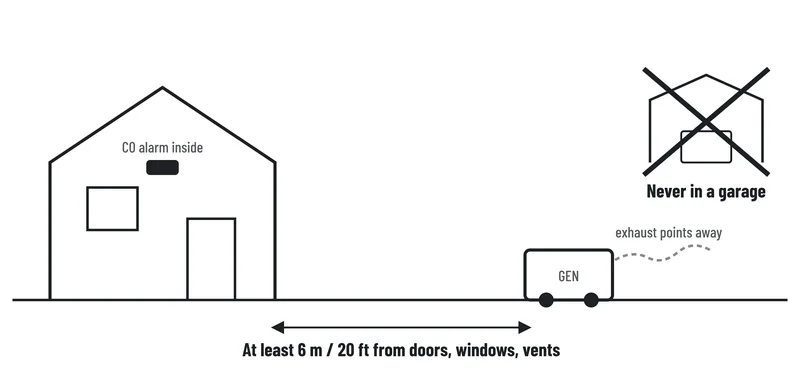
- Generators: outdoors only, at least 6 m (20 ft) from windows, doors, and vents, and never in a garage, even with the door open. Run a battery carbon monoxide (CO) alarm inside.
- Sanitation: if water stops, set up a bucket toilet (SKL-SAN).
- Security: lock doors, keep a light near exits, keep a low profile.
- Information: check official updates at fixed times to save batteries.
Beyond 24 hours
- By day two, decide whether to stay or go, based on temperature, water, medical needs, and safety. If you will leave, leave early, while fuel and roads are easier.
- Recharge phones and radios with solar panels or a vehicle charger. Run the engine only outdoors, in open air.
- Switch to your two-week supply routine (FND-KIT): drinking water first, washing water second.
- Join or start a neighborhood check-in: a shared bulletin board, a list of who needs help, and agreed meeting times.
- Watch for scams and rumors. Trust official channels.
3. What you need
| Priority | Item | Why | Product category |
|---|---|---|---|
| 1 | Flashlight or headlamp per person, spare batteries | Safe light | Headlamps, LED lanterns |
| 1 | Battery, hand-crank, or solar radio | News when internet and phones fail | Emergency radio |
| 1 | Stored water, 2 weeks | Pumps may stop | Water storage containers |
| 1 | Backup power for medical devices | Life safety | Portable power station, device batteries |
| 1 | Battery CO alarm | Generator and heater safety | CO alarm |
| 2 | Power banks and a solar charger | Phones and radios | Power banks, foldable solar panels |
| 2 | Cooler, ice packs, appliance thermometer | Food-safety decisions | Coolers, fridge thermometers |
| 2 | Shelf-stable food and a manual can opener | No cooking required | Emergency food kits |
| 2 | Camp stove and fuel (outdoor use) | Hot food and water | Camp stoves |
| 2 | Cold kit: sleeping bags, wool layers, hats | Keep body heat | Sleeping bags, thermal blankets |
| 2 | Heat kit: battery fans, cooling towels | Prevent heat illness | Battery fans |
| 3 | Cash in small bills | Card systems fail | — |
| 3 | Generator with a transfer switch (optional) | Long outages | Inverter generators |
4. What you must do
Procedure A: Protect your food
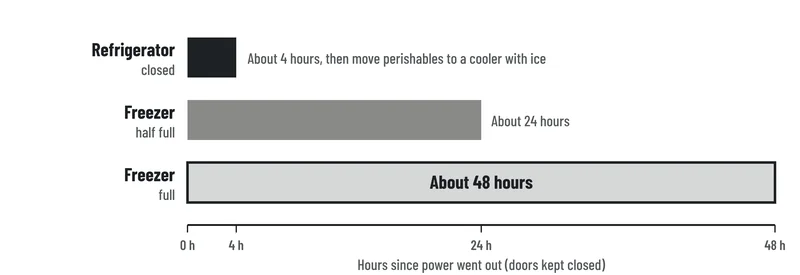
- Keep doors closed. A closed refrigerator generally keeps food cold for about 4 hours.
- A full freezer holds its temperature for about 48 hours; a half-full freezer for about 24.
- If the power is out for more than 4 hours, move milk, meat, fish, eggs, and leftovers into a cooler with ice.
- Throw out perishable food that has been above 4 °C (40 °F) for more than 2 hours. When in doubt, throw it out. Never taste food to test it.
Procedure B: Make a warm room
- Choose a small interior room with few windows. Avoid basements that flood.
- Close doors to other rooms; roll towels against gaps.
- Hang blankets over windows and the doorway.
- Insulate the floor with rugs, foam, or cardboard.
- Gather everyone there, pets too. Body heat adds up.
Procedure C: Run a generator safely
- Place it outdoors on a dry surface, with exhaust pointing away from any building. Keep it at least 6 m (20 ft) from windows, doors, and vents, as US guidance (Ready.gov) advises.
- Plug appliances directly into it with outdoor-rated cords of the right size.
- Never connect it to household wiring without a transfer switch installed by an electrician. "Backfeeding" can electrocute utility workers and neighbors.
- Let it cool before refueling. Store fuel away from the house.
Procedure D: When the power comes back
- Wait a few minutes, then switch appliances on one at a time.
- Check food with the rules above. Reset clocks, alarms, and medical devices.
- Refill water, replace batteries, and write down what you ran out of.
5. Safer locations
Check locally
Exact locations depend on your area. Find your official shelters, warming centers, and cooling centers now and write them on your plan.
- Your own prepared home is usually best for short outages.
- Official warming centers, cooling centers, and shelters often have backup power, staff, and first aid.
- Hospitals are for medical emergencies and power-dependent patients only; they may be under strain.
- Another grid area. Friends or family served by a different utility or region may still have power.
- Low-rise buildings are easier than high-rises, where elevators and water pumps stop.
- Homes on gravity-fed or well water keep water longer than those that depend on pumping.
What a local outage map should show you: your utility's service area and outage map (save its phone number, not just the web page), shelters and warming or cooling centers, critical facilities with backup power, and areas with planned safety shutoffs.
6. Places and actions to avoid
Avoid
- Elevators while power is unstable.
- Downed power lines. Assume they are live. Stay at least 10 m (33 ft) away and report them.
- Running engines or burning fuel in garages, basements, tents, or any enclosed space.
- Driving through dark intersections, and traveling at night when streetlights are out.
- Crowded stores and gas stations in the first hours, if you are already supplied.
- Upper floors of high-rises during long outages, especially for older people or people with limited mobility.
7. Long-term strategies and recovery
Recover and get stronger
- Spend ten minutes after every outage writing down what worked and what ran out.
- Size a small solar setup or portable power station for essentials: lights, radio, phones, and any medical device.
- Ask your utility whether it keeps a priority register for medical-device users.
- Improve insulation (door seals, window film, heavy curtains) so your home holds a safe temperature longer.
- Agree on a neighborhood plan: who has a generator or power station, who needs checking on, where to meet.
See
See also: SKL-WTR Water · SKL-FIRE Fire and CO safety · SKL-SHLT Shelter · SKL-FOOD Food · SKL-SAN Sanitation · SKL-COMM Communication · TECH-CYB · TECH-EMP · TECH-CME · NAT-HEAT · NAT-COLD
Quick card · TECH-GRID Grid Blackout
Now
- Check people and medical devices
- Flashlights, not candles
- Unplug electronics; leave one light on
- Fridge and freezer closed (fridge ~4 h)
- Radio on; phone on low power
Within 24 hours
- Text your out-of-area contact
- Check neighbors
- Fill water containers
- Set up a warm or cool room
- Generator outdoors, 6 m (20 ft) away; CO alarm on
If 3+ days
- Stay-or-go decision by day 2
- Switch to 2-week supply routine
- Neighborhood check-ins
General information only · Follow official guidance · Verify for your area
The rest of the book
The complete edition has 24 event chapters, 10 core skills, household plans, recovery, and 28 quick-reference cards to copy. The ebook is available now. The printed Guidebook and Field Kit follow once the printed proof is checked.